Anatomical precision
The harmony of function and aesthetics is the foundation of every procedure.
As a plastic surgeon, my work has always been defined by the unity of anatomical precision, function, and aesthetic proportions. For me, plastic surgery is not about spectacular transformations, but about conscious, responsible decisions and results that are sustainable in the long term.
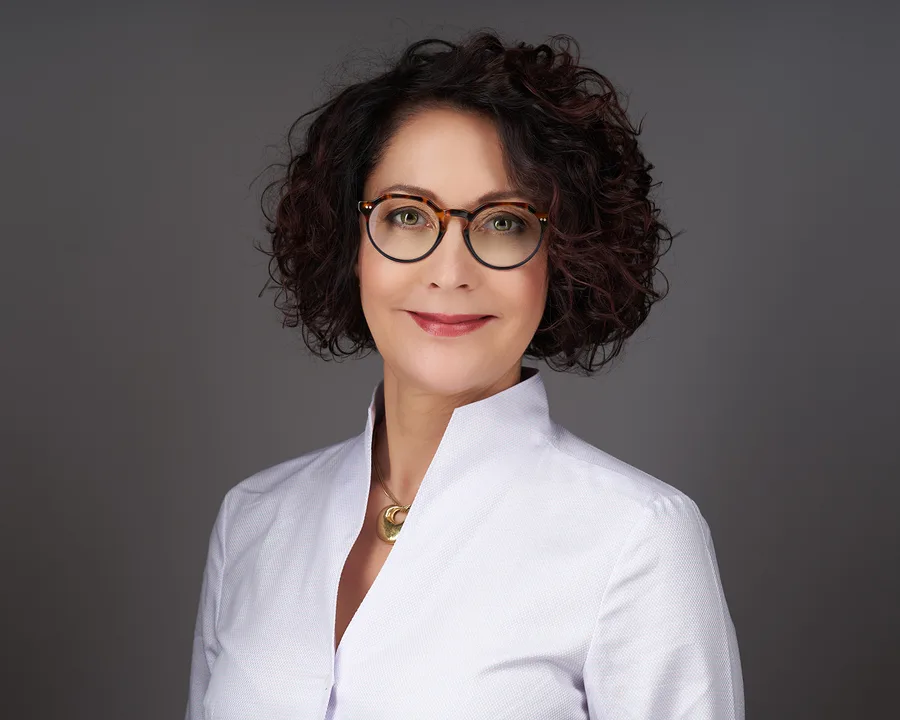
Get to know Dr. Varga Klára
Dr. Varga Klára has more than 20 years of experience in plastic surgery and otolaryngology. Her work is guided by anatomical precision, responsible decisions and a personalised approach — get to know her professional journey and philosophy below.
Work philosophy
The harmony of function and aesthetics is the foundation of every procedure.
Long-term sustainable results, ethical practice.
Every face is unique, every result is personalized.
Professional path
I obtained my medical degree from Semmelweis University of Medicine.
I began my career in otolaryngology, where I worked for ten years in a large regional hospital. During this time, I practiced the full spectrum of the specialty and related fields, while obtaining my otolaryngology board certification (1994).
While studying the reconstructive possibilities of the head and neck region, I came into contact with the rapidly developing, creative world of plastic surgery. I spent another ten years at the country’s leading plastic surgery department, where I obtained my plastic surgery board certification (2005), and became familiar with almost every area of the field, gradually specializing in rhinoplasty.
For more than ten years, I have been working in private practice, primarily performing complex, reconstructive, and revision procedures.
Harmony is most important to me in all areas of life. I strive for an intimate, trust-based relationship with my patients, because I believe that one of the keys to successful medicine is attentive listening and honest communication.
Approach
I always interpret rhinoplasty in the context of the entire face. I don’t view it as an independent form, but as part of a complex system where function, proportions, and individual character are all determining factors. The goal is not perfect form, but a natural result that fits the given face and is stable in the long term.
It’s important to me that the patient clearly understands both the possibilities and the limitations. The decision is the result of shared thinking, not a quick resolution.
What’s different about my rhinoplasty
Function and aesthetics cannot be separated. The nose is not a decorative object, but a functioning organ. Form modification can only be considered successful if breathing remains stable – or improves.
The decision is shared, not one-sided. Consultation is not “order–execution,” but shared thinking. Alongside ideas, what is achievable and why – and why not – is always discussed.
Individual proportions are more important than trends. Not a template nose is created, but a form that fits the entire face. The nose carries character; it should be refined, not eliminated.
Planning takes time. Good results don’t start in the operating room. Preparation, consideration of proportions, and discussion of expected changes are part of the process.
Without follow-up, there is no completed surgery. Rhinoplasty is not a one-day event. Follow-ups and longer-term monitoring are as much part of care as the procedure itself.
Stating reality frameworks is mandatory. Not every anatomy allows every change. These boundaries are better clarified upfront than disappointing later.
Honestly
Surgical philosophy and proportions
Consultation and planning
At the Vág Street office, I exclusively conduct specialist consultations, condition assessments, planning, and follow-up examinations. This is where detailed discussion of surgical plans takes place, with computer-aided planning when necessary.
Surgeries always take place in institutions with full infrastructure.
Consultation also includes patient education: detailed discussion of the healing process, expected changes, and long-term consequences.
Education and training
I am grateful that I was able to learn from the greatest authorities both at home and abroad. This enables me to treat my patients according to internationally recognized, modern methods.
University clinical training and practice (SOTE, POTE, SZOTE, HIETE), as well as regular domestic and international training courses, study tours, and conferences (Amsterdam, Munich, Innsbruck, Bergamo, Istanbul, Coventry).
Patient safety, professional predictability, and ethical practice form the foundation of all my decisions. I strive for solutions that are professionally sound, aesthetically restrained, and sustainable in the long term.